 ৫০% ছাড় সব কোর্সে!

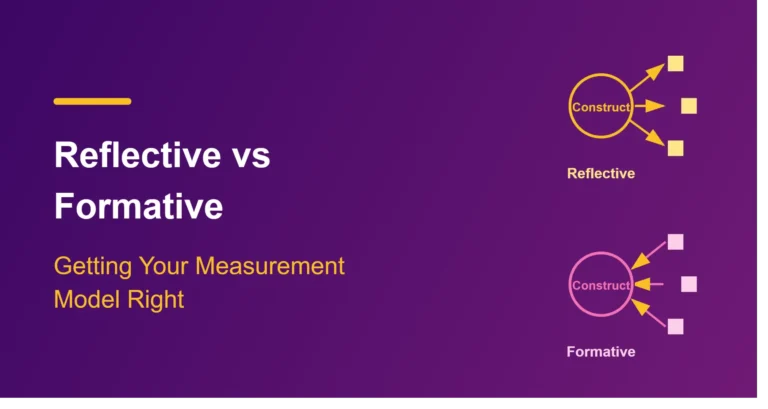
If you have worked with SmartPLS, PLS-SEM, or SEM in general, you already know that one decision quietly shapes the credibility of your entire study: is your construct reflective or formative? It sounds like a small technical detail buried in the methodology section, but getting it wrong can put your whole set of results on shaky ground.
Surprisingly, this is one of the most common mistakes researchers make, often without even realizing it. Many default to treating every construct as reflective simply because that is the more familiar option, without stopping to ask whether the underlying logic actually fits.
Why This Decision Matters So Much
In SEM, the measurement model defines the relationship between your latent construct (the abstract concept you cannot observe directly, like satisfaction or trust) and the indicators (the actual survey items or measured variables) used to capture it.
Choosing the wrong direction for this relationship does not just introduce a small statistical error. It can distort your validity assessments, produce misleading reliability statistics, and ultimately lead you to draw conclusions that do not accurately reflect what you are studying.
Understanding the Reflective Measurement Model
In a reflective measurement model, the relationship flows from construct to indicators. In other words, the latent construct is the cause, and the indicators are the effect. The underlying idea is that the construct exists independently, and each indicator is simply a reflection or manifestation of it.
Take Customer Satisfaction as a working example. You might measure it using items like satisfaction with the service, whether the service met expectations, and willingness to use it again. If a customer’s underlying satisfaction changes, we would expect their answers across all items to shift together in the same direction. That is the defining logic of reflective indicators.
Understanding the Formative Measurement Model
A formative measurement model works in the opposite direction. Here, the relationship flows from indicators to construct, meaning multiple indicators combine together to form or define the construct itself.
Socioeconomic Status, commonly abbreviated as SES, is a textbook example. It is typically built from indicators like monthly income, educational attainment, occupation, and accumulated assets. These factors combine to define what we mean by socioeconomic status. Unlike the satisfaction example, there is no reason to expect these indicators to move together or correlate strongly.
Different Models, Different Evaluation Criteria
Once you have correctly identified whether your construct is reflective or formative, the statistical tests you run to validate it change significantly.
For reflective models, researchers typically evaluate reliability using measures like Cronbach’s Alpha and Composite Reliability, Average Variance Extracted for convergent validity, and discriminant validity to confirm the construct is genuinely distinct from others.
For formative models, the evaluation criteria shift toward indicator weights and their statistical significance, along with collinearity, typically assessed through the Variance Inflation Factor, since overlapping formative indicators can distort the model.
Applying reflective validity criteria, like Cronbach’s Alpha or AVE, to a formative construct is a common and serious error, because these tests assume high inter-item correlation, which formative indicators are not expected to have in the first place. This mismatch is precisely where many researchers unknowingly undermine their own results.