 ৫০% ছাড় সব কোর্সে!

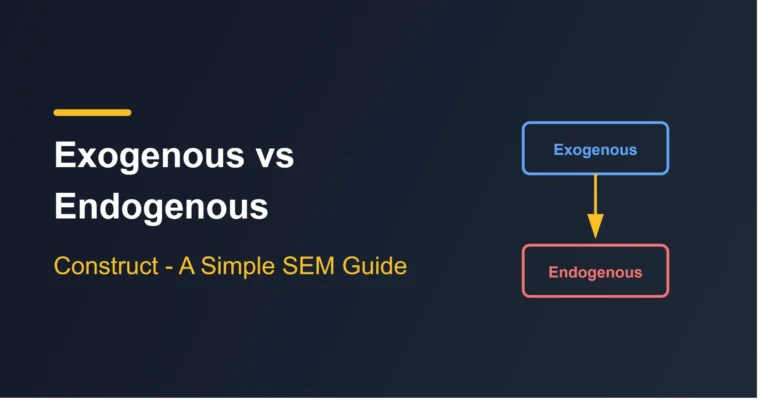
If you have spent any time working with Structural Equation Modeling, SmartPLS, or AMOS, you have run into the term “construct” more times than you can count. Yet despite how often it comes up, a surprising number of new researchers still find themselves unsure what a construct actually is, and even more confused about the difference between exogenous and endogenous constructs.
The good news is that once you break it down, this concept is far simpler than it sounds. Let’s walk through it step by step.
What Exactly Is a Construct?
A construct is a concept or characteristic that cannot be observed or measured directly, but can be captured indirectly through a set of questions, known as indicators or items.
Think about ideas like Customer Satisfaction, Trust, Motivation, Brand Loyalty, or Technology Adoption Intention. You cannot hand someone a ruler and measure their trust the way you would measure height or weight. Instead, researchers rely on multiple carefully worded questions that, together, approximate this hidden or latent concept.
This is precisely why constructs are often called latent variables. They exist conceptually, and their presence is inferred through the pattern of responses to related indicators rather than through direct observation.
Exogenous Constructs: The Starting Point of Your Model
An exogenous construct functions much like an independent variable in traditional statistical analysis. It is not caused or explained by anything else within your model. Instead, its value is determined by factors outside the model itself.
A few defining characteristics make exogenous constructs easy to spot: they are not explained by any other construct within your structural model; in a path diagram, no arrows point toward them, instead arrows originate from them and point outward toward other constructs; and they essentially act as the starting point or trigger within your model’s causal chain.
Consider this example: Performance Expectancy leads to Behavioral Intention. In this relationship, Performance Expectancy is the exogenous construct. Nothing else in the model is explaining or predicting it.
Endogenous Constructs: The Outcomes Within Your Model
An endogenous construct, on the other hand, operates like a dependent variable. It is influenced or explained by other constructs within the model, and this is exactly where your model’s explanatory power comes into play.
Here’s what typically characterizes an endogenous construct: it is affected by one or more other constructs inside the model; its variation can be explained, at least partially, by those upstream constructs; and in a path diagram, arrows point toward it, showing the direction of influence coming from other variables.
Going back to the same example, Behavioral Intention is the endogenous construct here. It is the outcome being explained, shaped by the influence of Performance Expectancy pointing into it.
A Simple Way to Remember the Difference
If you ever find yourself second-guessing which construct is which, remember: exogenous equals cause, endogenous equals effect. Alternatively, exogenous equals independent variable, and endogenous equals dependent variable.
Once this framing clicks, identifying exogenous and endogenous constructs in even a fairly complex structural model becomes much more intuitive. You are essentially just asking: does this construct have arrows going out, or coming in?